350-101 Latest Mock Exam, 350-101 Latest Test Vce
Wiki Article
After years of operation, our platform has accumulated a wide network of relationships, so that we were able to learn about the changes in the exam at the first time. This is a benefit that students who have not purchased 350-101 exam guide can't get. The team of experts hired by Implementing and Operating Cisco Wireless Core Technologies study questions constantly updates and supplements the contents of study materials according to the latest syllabus and the latest industry research results. We also have dedicated staff to maintain 350-101 Exam Material every day, and you can be sure that compared to other test materials on the market, Implementing and Operating Cisco Wireless Core Technologies study questions are the most advanced. With 350-101 exam guide, there will not be a situation like other students that you need to re-purchase guidance materials once the syllabus has changed. 350-101 exam material not only helps you to save a lot of money, but also let you know the new exam trends earlier than others.
Cisco 350-101 Exam Syllabus Topics:
| Topic | Details |
|---|---|
| Topic 1 |
|
| Topic 2 |
|
| Topic 3 |
|
| Topic 4 |
|
| Topic 5 |
|
>> 350-101 Latest Mock Exam <<
Cisco 350-101 Latest Test Vce - 350-101 Pass4sure Study Materials
To help applicants prepare successfully according to their styles, we offer three different formats of Implementing and Operating Cisco Wireless Core Technologies (350-101) exam dumps. These formats include desktop-based Implementing and Operating Cisco Wireless Core Technologies (350-101) practice test software, web-based Cisco 350-101 Practice Exam, and Building Implementing and Operating Cisco Wireless Core Technologies (350-101) dumps pdf format. Our customers can download a free demo to check the quality of 350-101 practice material before buying.
Cisco Implementing and Operating Cisco Wireless Core Technologies Sample Questions (Q103-Q108):
NEW QUESTION # 103
How does MIMO operate during wireless transmission?
- A. It limits data paths to a single antenna for error reduction.
- B. It shares a single connection among endpoints for coverage expansion.
- C. It uses multiple radio paths to increase throughput and reliability.
- D. It applies frequency hopping to prevent crosstalk.
Answer: C
Explanation:
MIMO, or Multiple-Input Multiple-Output, is a core 802.11n and later wireless technology that uses multiple transmit and receive radio chains and antennas to improve wireless performance. Cisco's Wireless RF Reference Guide explains that IEEE 802.11n introduced MIMO, replacing the older single-radio SISO model with multiple radios, each using its own antenna, to increase data rates and improve reception in multipath environments. Cisco also notes that weak or distorted multipath signals can be received by more than one radio and reconstructed, improving decode quality and reliability.
This directly supports option A: MIMO exploits multiple RF paths rather than treating multipath as purely destructive. Depending on implementation, MIMO can use spatial diversity, maximal ratio combining, and spatial streams to increase throughput, improve signal-to-noise ratio, reduce retries, and make more efficient use of airtime. Cisco describes spatial stream notation such as 4x4:4 as four transmitters, four receivers, and four spatial streams. Option B describes frequency hopping, not MIMO. Option C is not a MIMO function.
Option D is the opposite of MIMO because MIMO deliberately uses multiple antennas and radio paths.
Reference topics:802.11 Technology Fundamentals - MIMO, spatial streams, multipath, SISO versus MIMO, and 802.11n/ac/ax PHY enhancements.
NEW QUESTION # 104
Exhibit: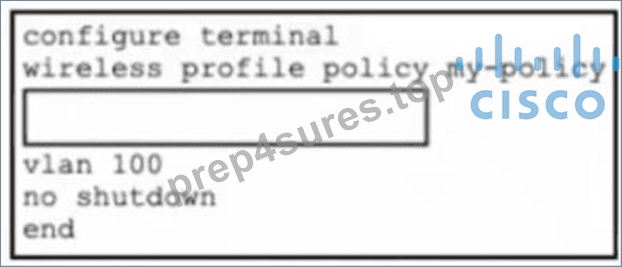
Refer to the exhibit. An enterprise is deploying Cisco Catalyst 9800 WLCs and is using Catalyst Center as the management platform to oversee wireless access policies. To meet the organization's compliance requirements, all wireless endpoints must be evaluated with security posture validation before gaining access.
Which set of CLI commands must be added to the box in the code to complete the configuration?
- A. wireless profile policyaaa-override
- B. aaa-overridenac-policy
- C. aaa-overridenac
- D. wireless profile policy my-policyaaa-override
Answer: C
Explanation:
The correct configuration isaaa-overridefollowed bynacunder the existing Catalyst 9800 wireless policy profile. The exhibit already places the administrator in policy-profile configuration mode with wireless profile policy my-policy, so the missing commands must be policy-profile subcommands, not another profile declaration. Cisco's Catalyst 9800 configuration examples show the exact sequence: enter wireless profile policy < policy-profile-name > , enable aaa-override, enable nac, then configure VLAN and no shutdown.
aaa-override permits authorization attributes returned by AAA or Cisco ISE, such as VLAN, ACL, QoS, redirect ACL, or posture-related access controls, to override the locally defined policy. Cisco's documentation explicitly states that AAA override applies policies coming from AAA or ISE servers, while nac enables Network Access Control in the policy profile. This is the required behavior when endpoints must be posture- validated before normal network access is granted. Cisco also notes that NAC State is enabled in the policy profile and can only be enabled when AAA override is enabled.
Option A is invalid because nac-policy is not the correct CLI keyword. Options B and D omit NAC.
Reference topic:Client Connectivity Configuration - Catalyst 9800 policy profiles, AAA override, NAC State, posture enforcement, and ISE-based access control.
NEW QUESTION # 105
How does U-NII-1 operate with regards to the common frequency bands supported in enterprise wireless networks?
- A. It defines subsections with signal handling and is restricted to indoor use helping minimize interference.
- B. It defines class limits for specialty devices and is restricted to outdoor use increasing coverage.
- C. It uses a range of lower frequencies with restrictions on transmit power used indoor and outdoor.
- D. It uses a range of higher frequencies and tile enforcement with static power configuration.
Answer: A
Explanation:
U-NII-1 (Unlicensed National Information Infrastructure-1) is a segment of the 5 GHz band commonly used in enterprise wireless deployments. It is specifically designated for indoor use to help minimize interference with other devices and reduce regulatory conflicts. U-NII-1 operates in the lower 5 GHz range (5.150-5.250 GHz in the U.S.) and imposes power and indoor restrictions, which prevents outdoor deployment that could interfere with radar and other critical communications. This band supports 802.11a/n/ac/ax Wi-Fi clients, providing multiple non-overlapping channels that facilitate high-density enterprise deployments. By restricting usage to indoor environments, U-NII-1 helps maintain predictable coverage and mitigates interference from outdoor sources, making it ideal for office and campus environments where controlled radio propagation is critical. The access points and wireless controllers dynamically handle channel assignment and power levels to ensure efficient spectrum usage while conforming to these regulatory limitations. Option C accurately reflects these operational parameters by highlighting indoor restriction and interference minimization, whereas the other options mischaracterize the frequency range, power, or permitted use.
Reference topics:802.11 Technology Fundamentals - U-NII-1 band, indoor use restriction, interference mitigation, enterprise 5 GHz Wi-Fi deployment.
NEW QUESTION # 106
Which solution enables a seamless user experience when roaming in a wireless network?
- A. optimized roaming
- B. static VLAN policy
- C. fast transition
- D. redundant RF profile
Answer: C
Explanation:
Fast transition is the correct solution because it refers to IEEE 802.11r Fast BSS Transition, which reduces the authentication delay when a wireless client roams from one AP to another. Cisco describes 802.11r Fast Transition as a feature for seamless wireless roaming and states that, after configuration, the WLAN supports faster client roaming between access points. Cisco's Catalyst 9800 roaming documentation also identifies
802.11r as the mechanism focused on seamless transition between APs, while 802.11k and 802.11v assist with neighbor reporting and network-assisted roaming decisions.
The core advantage is that key negotiation and authentication preparation occur before or during the roam, reducing the interruption experienced by latency-sensitive applications such as voice, video, collaboration tools, and real-time enterprise applications. Static VLAN policy only controls segmentation and does not accelerate roaming. Optimized roaming can help discourage sticky clients from remaining associated to poor- quality APs, but it is not the primary fast-roam authentication mechanism. A redundant RF profile is not an
802.11 roaming solution. Reference topics:802.11r Fast BSS Transition, client roaming, WLAN mobility behavior, Catalyst 9800 WLAN security, and seamless roaming design.
NEW QUESTION # 107
A network administrator at a construction company manages a Cisco Catalyst 9800 Series Wireless Controller running Cisco IOS XE 17.x. The WLAN named XYZ-Conference is set up for a large event, but attendees report slow network performance due to misbehaving clients. To improve connectivity, the network administrator decides to change the client exclusion policy on the WLAN to temporarily block the misbehaving clients. The XYZ-Conference WLAN must enable a client exclusion policy with a timeout of
120 seconds for misbehaving clients. Which set of Cisco IOS XE commands must be used?
- A. wireless profile policy XYZ-Conferenceexclusionlist timeout 120
- B. wireless profile policy XYZ-Conferenceclient-exclusion 120
- C. wireless profile policy XYZ-Conferencesecurity exclusion timeout 120
- D. wireless profile policy XYZ-ConferenceXYZ Conference exclude 120
Answer: B
Explanation:
Client exclusion is a feature in Cisco Catalyst 9800 WLCs that allows the administrator to temporarily block clients exhibiting misbehavior, such as excessive retries, excessive bandwidth usage, or roaming issues. The IOS XE CLI command for enabling client exclusion in a WLAN policy isclient-exclusion < timeout > , where
< timeout > defines the duration (in seconds) the client is prevented from associating with the WLAN. Option D correctly usesclient-exclusion 120to block the misbehaving clients for 120 seconds. Option A (exclude 120) is not valid IOS XE syntax. Option B (exclusionlist timeout 120) is also incorrect as it refers to internal exclusion lists, not the WLAN policy applied to live clients. Option C (security exclusion timeout 120) is invalid and does not configure client exclusion at the WLAN policy level. Cisco Wireless Core Technologies emphasize using client exclusion policies during high-density events or temporary network congestion to ensure network fairness, protect overall WLAN performance, and maintain connectivity for well-behaving clients. Reference topics:Client Connectivity Configuration - Client exclusion, WLAN policy, misbehaving client mitigation, Cisco Catalyst 9800 IOS XE.
NEW QUESTION # 108
......
Our 350-101 practice materials have picked out all knowledge points for you, which helps you get rid of many problems. In addition, time is money in modern society. It is important achieve all things efficiently. So our 350-101 study guide just needs less time input, which can suit all people’s demands. In the meantime, all knowledge points of our 350-101 Preparation questions have been adapted and compiled carefully to ensure that you absolutely can understand it quickly.
350-101 Latest Test Vce: https://www.prep4sures.top/350-101-exam-dumps-torrent.html
- 350-101 Test Questions ???? 350-101 Latest Exam Test ???? 350-101 Download Pdf ???? Search for ➤ 350-101 ⮘ and easily obtain a free download on ✔ www.troytecdumps.com ️✔️ ????Valid 350-101 Exam Papers
- 350-101 Download Pdf ???? 350-101 Test Questions ???? 350-101 Test Dumps Free ◀ Search for ⮆ 350-101 ⮄ and download it for free on ➤ www.pdfvce.com ⮘ website ????350-101 Latest Exam Testking
- 350-101 Study Guides ✔ 350-101 Certified ???? 350-101 New copyright Ebook ???? Open website ⏩ www.prepawaypdf.com ⏪ and search for { 350-101 } for free download ????350-101 Valid copyright Ebook
- High 350-101 Passing Score ???? Latest 350-101 copyright ???? 350-101 Test Dumps Free ???? Easily obtain ⏩ 350-101 ⏪ for free download through { www.pdfvce.com } ????New 350-101 Test Test
- 350-101 Test Questions ???? 350-101 Training Materials ❤️ 350-101 Download Pdf ???? Search for { 350-101 } on 「 www.validtorrent.com 」 immediately to obtain a free download ▛350-101 Download Pdf
- 100% Pass Quiz 2026 Cisco High Hit-Rate 350-101 Latest Mock Exam ???? Copy URL ✔ www.pdfvce.com ️✔️ open and search for ✔ 350-101 ️✔️ to download for free ????350-101 Latest Exam Testking
- 350-101 Certified ⏯ 350-101 Download Pdf ⛅ 350-101 Certified ➡️ Search for 「 350-101 」 and download exam materials for free through ( www.examdiscuss.com ) ????350-101 Latest Exam Test
- Start Cisco 350-101 Exam Preparation Today And Get Success ???? Immediately open [ www.pdfvce.com ] and search for ➤ 350-101 ⮘ to obtain a free download ????350-101 Latest Exam Testking
- 350-101 Certified ???? 350-101 Certification Exam Dumps ???? 350-101 Study Guides ???? Search for [ 350-101 ] and obtain a free download on ➠ www.pdfdumps.com ???? ????350-101 Training Materials
- Start Cisco 350-101 Exam Preparation Today And Get Success ???? Download { 350-101 } for free by simply searching on 《 www.pdfvce.com 》 ????350-101 Training Materials
- 350-101 Latest Exam Testking ???? Exam 350-101 Answers ???? 350-101 Certification Exam Dumps ???? Easily obtain ⇛ 350-101 ⇚ for free download through ➠ www.testkingpass.com ???? ????350-101 Certification Exam Dumps
- www.stes.tyc.edu.tw, tasneemwtdt572552.smblogsites.com, try.drmsobhy.net, coursecrafts.in, andrewcqts217138.angelinsblog.com, learn.csisafety.com.au, theowvnt570559.sasugawiki.com, xanderbfpg437324.blogproducer.com, nikolasyjbe818267.anchor-blog.com, exxpertscm.com, Disposable vapes